
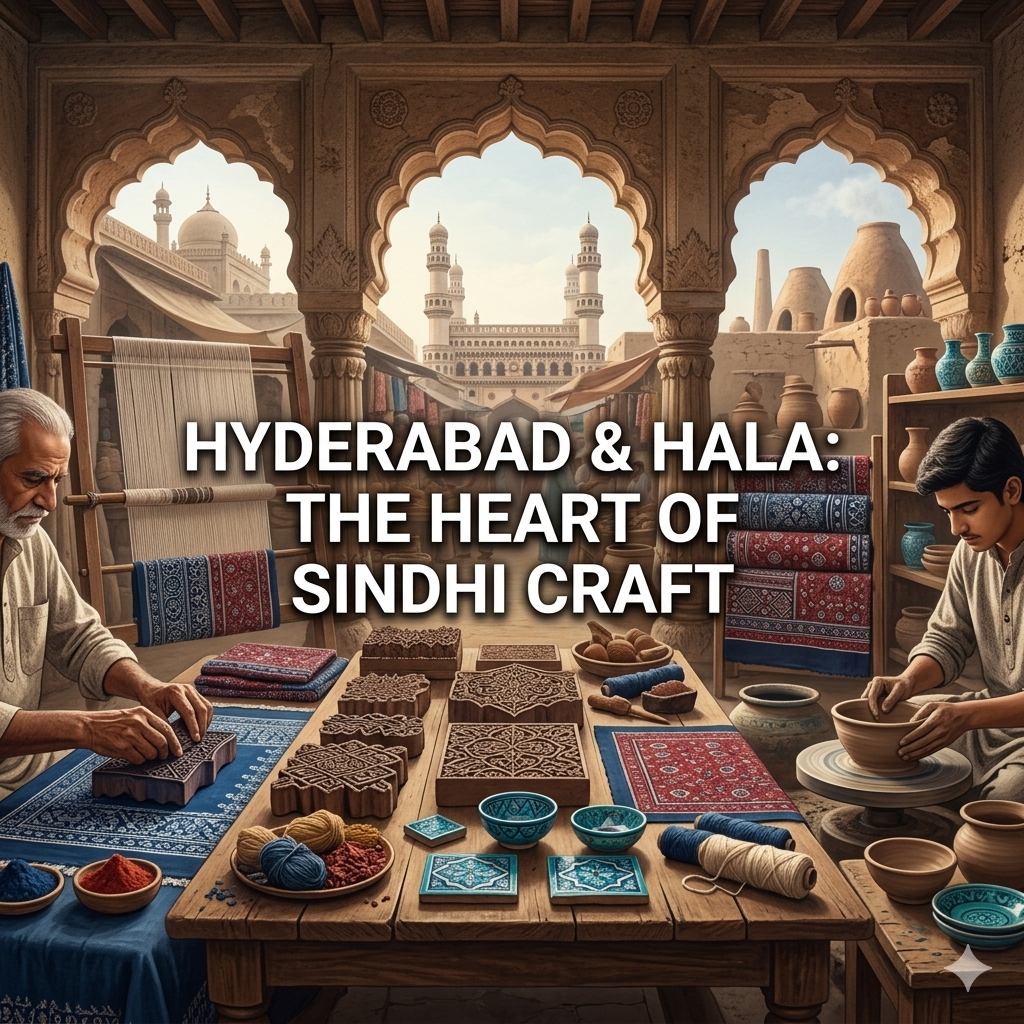

Hyderabad & Hala: The Heart of Sindhi Craft
For this month’s feature of mapping Pakistani craftsmanship, I have chosen two cities known not only for their history but also for the skills that have been practiced there for generations. Hyderabad and Hala, in Sindh, Pakistan. For anyone familiar with Sindhi culture, these cities are closely connected to some of the region’s most respected craft traditions.
Let’s talk about Hyderabad first. Hyderabad has long been an important cultural and commercial center of Sindh. During the Talpur rule in the 18th and early 19th centuries, it became a place where artisans, traders and craftsmen gathered. Many communities that specialized in particular crafts settled here and continued their work through generations. Even today, if you walk through some of the old city areas, you will find small workshops where traditional techniques are being practiced much in the same way they were decades ago.
The Ajrak Printing Legacy in Hyderabad
One of the crafts most closely associated with Hyderabad is Ajrak printing. Ajrak is more than a textile pattern. It represents a long and detailed process of fabric preparation, natural dyeing and block printing. The work requires patience and precision. Wooden blocks are carved with geometric patterns and repeatedly pressed onto fabric through several stages of printing and dyeing. The deep indigo blues and rich reds that appear on finished Ajrak cloth are the result of multiple steps that can take weeks to complete.
Many of the families involved in Ajrak production today have inherited the craft from earlier generations. Knowledge of block carving, dye preparation and printing methods is often learned at home rather than through formal training. Over time, these skills become second nature to the artisans who practice them.
Hala: The Town of Glazed Ceramics and Weaving
Not far from Hyderabad is the town of Hala. Hala is widely known across Pakistan for its craftsmanship. Although smaller in size, Hala has built a strong reputation for several traditional crafts, particularly ceramics and handloom weaving.
Hala pottery is especially well known for its glazed ceramic work, often referred to as Kashigari. The bright blues, turquoise shades and geometric patterns seen on Hala ceramics have historical connections to design traditions that travelled through Persia and Central Asia centuries ago. Over time, local artisans adapted these influences into their own distinctive style. Today, ceramic bowls, tiles and decorative pieces from Hala are recognized across Pakistan and increasingly appreciated abroad.
The Continuity of Knowledge
Another important craft in Hala is handloom weaving. In small workshops, artisans continue to produce fabrics using wooden looms that have been used for decades. The weaving process is slow and careful, requiring close attention to the threads and patterns being formed. The fabrics produced here often feature traditional Sindhi designs and are valued for their durability and craftsmanship.
What makes Hyderabad and Hala significant is not just the products that come from these places but the continuity of knowledge that has allowed these crafts to survive. Many artisan families can trace their work back several generations. Skills are passed down informally, often beginning when children observe and assist their elders at a young age.
Preserving Tradition in the Industrial Age
In recent years, traditional crafts across South Asia have faced increasing pressure from industrial production and cheaper machine made alternatives. For many artisans, maintaining these practices while earning a sustainable income has become a challenge. Despite this, Ajrak printing, pottery and weaving have continued to survive in Hyderabad and Hala.
There has also been growing interest in handmade and culturally rooted products, both within Pakistan and internationally. Designers, cultural organizations and small businesses are working with artisans to introduce these traditional crafts to new audiences while preserving the techniques that define them.
Hyderabad and Hala therefore remain important centers of Sindhi craftsmanship. Their workshops, artisan families and long standing techniques represent a living connection between the past and present. Through Ajrak, pottery and woven textiles, these cities continue to preserve traditions that form an important part of Sindh’s cultural identity.