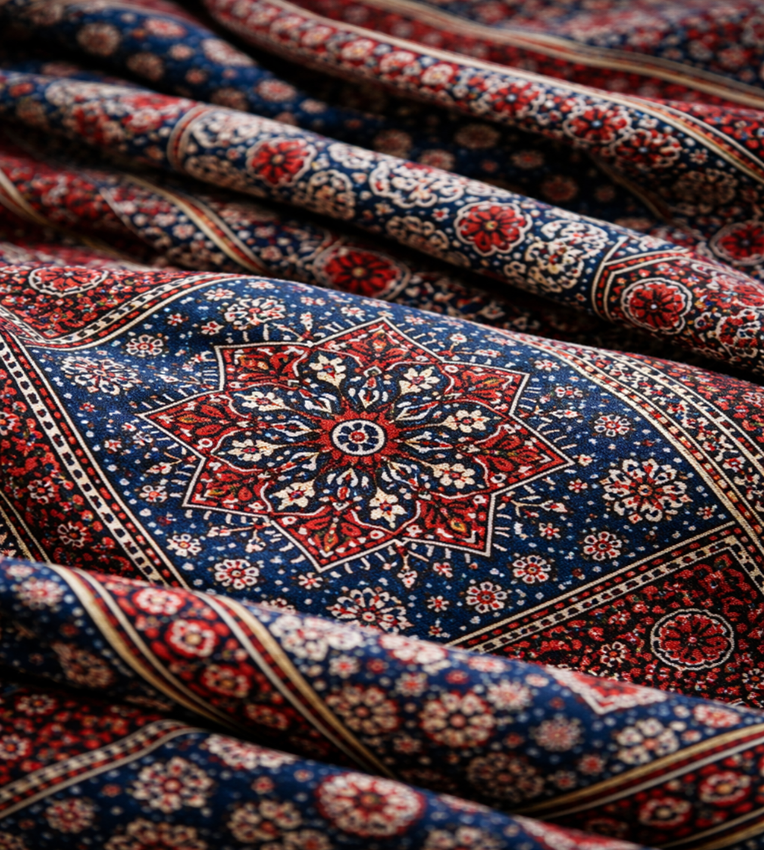

As someone who has spent her life in Karachi, with family in Hyderabad as well, Ajrak is a fabric I grew up seeing, worn and perpetually present in everyday life. Yet, I will admit something honestly. When I was younger, I thought of Ajrak as a simple, almost ordinary fabric. How wrong I was! What I failed to see then is what time eventually revealed. Ajrak is not merely a textile. It carries within its deep indigo and rust red patterns the memory of Sindh itself. Its rivers, its soil, its artisans and centuries of culture stamped into cloth.
In Pakistan, Ajrak is not simply a textile. It is a piece of pride on a farmer’s shoulder in interior Sindh, the ceremonial gift offered to a respected guest, an ancient craft passed from father to son, mother to daughter, across generations who never considered themselves artists because creation was simply life.
The Roots
Ajrak is historically rooted in Sindh, which today lies mostly in Pakistan, but its cultural footprint extends across parts of western India. Many historians trace it back to the Indus Valley Civilization, whose urban marvel, Mohen-jo-daro, revealed patterned textiles and dyeing knowledge that resemble the geometry we see today in Ajrak’s intricate stars and grids.
Imagine the Indus Valley Civilization thousands of years ago, the artisans creating these masterpieces on the banks of the Indus River, clay vats of dyes made using earthy minerals and plants. Ajrak is almost like the ancient culture that shaped the Sindhi identity.
Over centuries, through Arab influence, Mughal aesthetics and local Sindhi evolution, Ajrak refined itself. It is more than just dyed fabric now. In Sindh, it is worn with the Sindhi cap. During protests, it becomes a cultural statement. In moments of celebration, it becomes honor.
How Ajrak Is Made
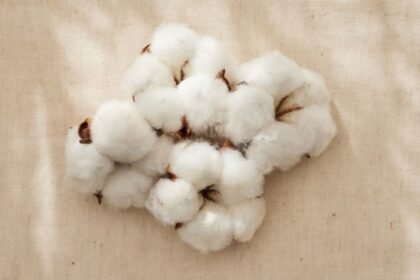
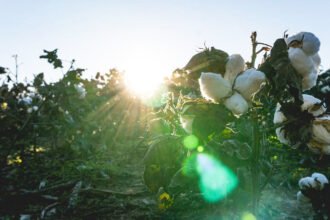
Ajrak is painfully slow. The making of a single authentic Ajrak can take weeks, sometimes more. It begins with untreated cotton, washed repeatedly to remove impurities. Traditionally, artisans use natural ingredients like soda ash, castor oil and even camel dung in certain stages to prepare the cloth. It may appear rustic, but it is actually the result of centuries of practical chemistry developed through careful observation and experience.
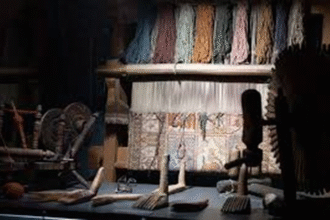
Then come the wooden blocks, hand carved masterpieces, often by specialized craftsmen in Sindh. Each block represents one layer of the final design. Ajrak is not printed in one go, it is built in stages, like architecture.
The colors are the most defining elements of Ajrak.
- Indigo blue, drawn from natural indigo vats.
- Rust red, extracted from plant roots.
- Black, created from iron and jaggery mixtures that oxidize into rich darkness.
The printer carefully aligns the block and presses it onto the fabric with steady hands. The process requires accuracy because mistakes cannot be corrected once the block is printed. Each stamp has to be placed correctly the first time.
After printing, the fabric is dipped into dye vats, laid out under the sun, washed in flowing water (traditionally river water) then dyed again. This repetition gives Ajrak its depth. All this is painstakingly slow and time consuming, but that’s the beauty of it.
Ajrak as a Cultural Identity
In Pakistan, Ajrak is not merely a fashion statement, it is Sindh’s identity.
In rural Sindh, you will see men draping it over their shoulders as protection from the sun and dust. At weddings, Ajrak is gifted as respect. Political leaders are often welcomed with an Ajrak as a mark of honor. During cultural days in Karachi, Hyderabad or Sukkur, schools and offices are covered with indigo and red.
It transcends class. It transcends occasion. It is both a daily and sacred ritual.
In recent decades, Ajrak has also become a symbol of cultural resilience. When globalization threatened to blur identities, Sindh wrapped itself more tightly in its Ajrak.
From Villages to Global Shows
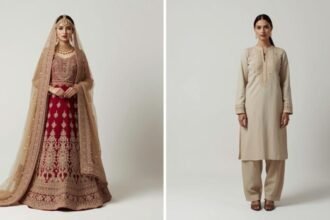
Today, Ajrak has stepped beyond tradition without losing its roots. Pakistani designers have reimagined it into contemporary silhouettes. Structured jackets, flowing kaftans, statement dupattas, luxury scarves. It has appeared in curated exhibitions, heritage showcases and high end collections that celebrate indigenous craft.
Growing global interest in sustainability has also brought renewed attention to Ajrak. At a time when much of the fashion industry relies on synthetic materials and fast, disposable production, Ajrak demonstrates that textiles can be made using natural dyes, traditional techniques, and processes designed to last.
International buyers increasingly seek authentic hand block textiles. Museums and cultural institutions reference Sindhi Ajrak as one of South Asia’s most sophisticated resist printing traditions. And yet, the base remains in small workshops, often family run, where knowledge is inherited.
The Challenges
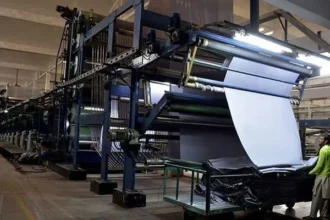
But there’s also fear of this craft becoming extinct. Machine printed imitations flood the markets at lower prices. Younger generations sometimes drift away from craft due to financial uncertainty. Access to natural dye materials fluctuates. Water pollution threatens traditional processes.
If Ajrak is to survive, Pakistan must protect it through
- Geographic indication protections.
- Design innovation support.
- Fair trade and artisan wage guarantees.
- Credit to the maker, not just the product.
This is pure economic strategy. Craft industries can strengthen rural economies, empower women artisans and position Pakistan globally as a country of heritage excellence, not just mass manufacturing.
The Future
The future of Ajrak should not be limited to museums. It requires stronger collaborations between heritage artisans and contemporary designers. Support from the government is essential to empower rural artisans, showcase their work globally and lead the conversation on sustainability proving that what the world now calls slow fashion has long been embedded in our culture.
Ajrak has survived empires, colonization, industrialization and globalization. It has absorbed change without losing its soul. And I feel, that is its greatest lesson for Pakistan itself. In a country often navigating uncertainty, Ajrak remains steady.
Ajrak is not simply a cloth from Sindh, it is a part of Pakistan’s historic identity.