

Karachi and its Textile Inheritance
I write about Karachi so often that people around me are perplexed. But this crumbling piece of land is the only home I have ever known. I’ve built my life here. I started and built my factory from scratch here. And so, I will write about Karachi as a textile hub, from a textile / garment manufacturer’s perspective.
We all know Lyari but west of the Lyari River is SITE, the Sindh Industrial Trading Estate. It was laid out in 1947, the same year as everything else, when this was still a city absorbing more people than it actually could. Valika Textile Mills opened there in 1948, the first textile mill in the country and Jinnah himself came to lay its foundation stone. I think about that sometimes when I’m driving past SITE these days, that the very first thing this newly drawn country decided to build, in the same year it was still deciding what it even was, was a textile mill, a place to spin thread into cloth.
Then came Landhi and Korangi in the following decade, Korangi built under Ayub Khan’s resettlement plan, housing laid down next to factory floors so that people displaced by Partition wouldn’t have to travel far to work. Karachi’s fate seemed to have been sealed automatically, the kind of city it was going to be, decided almost by default.
“It became a working city, a city where the workers’ colonies and the industrial estates were planned together because the people who built this place understood something we’ve sort of forgotten since… that a city doesn’t just house its labor, it is built around it.”
Karachi’s Industrial Blueprint
- SITE (Sindh Industrial Trading Estate): Established in 1947, home to Pakistan’s very first spinning and weaving units.
- Landhi & Korangi: Planned workers’ colonies integrated with factory floors to maximize proximity and productivity.
- The Port Link: Seamless supply chain connections where manufacturing units align directly with global cargo routes.
The Power of the Harbor
In recent months, I am increasingly thinking about that history, especially in terms of textiles. Every time someone describes Karachi to me as chaotic, ungovernable, a city that just happened rather than one that was made, I think about its early days and how it came to be. Deliberately, urgently, by people rebuilding a country with almost nothing, who looked at a fishing port on the edge of the Arabian Sea and understood its real value.
The harbor. Everything, SITE, Landhi, Korangi, the export processing zone at Port Qasim decades later, sits where it sits because someone drew a line from a manufacturing unit to a ship and refused to let the distance between them be an accident.
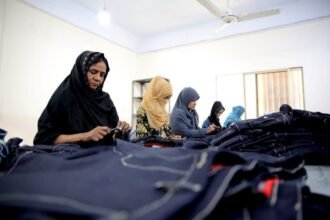
I didn’t choose this city’s industrial memory. It chose me, the way inheritance does, before I was old enough to know I was receiving anything. My factory sits inside that same geography and its geographical logic laid down eighty years ago. The proximity to the port, proximity to the workforce and their skill in turning fabric into something a person in another country will wear. When I walk my own floor, I am standing in the same relationship to Karachi that Valika stood in, that the families who built Korangi’s shop floors stood in.
This is the Karachi I wish more people see when they think about this place, especially the version of it that only appears in headlines about violence or collapse. There is this resilient Karachi running beneath all the chaos, a Karachi of gates and shift changes and looms that have been turning since before I was born, a Karachi that has employed, fed and housed more people through manufacturing than any single government program has managed in the same eighty years. Between 1947 and 2000, the number of textile mills in this country grew from three to six hundred, and an enormous share of that growth happened here, on this coastline, because the city itself was engineered to make it possible.
A Legacy Left to Erode
And yet. I would be lying if I didn’t say what this city has also let happen to the very thing it was built for. The energy crisis that has closed more than a hundred factories in recent years didn’t spare Karachi’s industrial belt. Some of the oldest estates in the country have watched their power cuts stretch past ten hours a day, watched export orders get turned away due to no fault of their own.
The port that made this city matter to the world is still here, but the roads leading to it, the water systems feeding the factories around it, the basic reliability a manufacturing city needs to keep functioning, all of it has been left to erode in a way that feels less like a decline and more like abandonment, one budget at a time.
“I grieve Karachi the way you grieve something that is still alive but you’re losing. Not gone but diminishing. A city that still stands beneath all the traffic and the noise, the bones of one of the most deliberately built industrial economies in South Asia and that keeps being asked to run on those eighty year old bones without anyone investing in new ones.”
Why We Stay
But then, why do I stay? I could set up a unit elsewhere with fewer power cuts and better roads. People ask me if I consider Lahore or Faisalabad, with better infrastructure. But this city gave the entire shape of my working life. The port that made export possible, the industrial estates that gave a small buying agency somewhere to become a factory, the eighty years of accumulated hands that know how to cut and stitch and finish a garment to a standard the rest of the world will accept.
I don’t know how to separate my gratitude for all that Karachi has given me, from my grief over how carelessly it’s being maintained. Maybe I’m not supposed to. Maybe loving a manufacturing city, really loving it, means holding both at once. The mill Jinnah opened in 1948 and the ten-hour power cut even today, the port that built this economy and the roads nobody has fixed since I was young enough to not yet know what a supply chain was—I actually love it all.
Karachi didn’t just happen to me. It built me as a garment manufacturer for the world. The least I can do is keep telling the truth about what it would take to keep it standing.
Reported for Farm Fabric Fashion | Covering the Future of the Textile Supply Chain