
How Pakistani Designers Could Use 3D Fashion to Go Global
Fashion and fashion manufacturing have come a long way and in 2026, it really feels like we’re living in a sci-fi movie. A few years ago, fashion used to be simple. Cut the fabric, stitch the garment, show it on a runway and send it to stores. Today, things have changed and design often begins in software.
The designers and manufacturers are now moving from physical samples to design renders. And 3D fashion is where technology and creativity converge. For an industry like Pakistan’s, with a cultural history in craft and design, and with a robust manufacturing ecosystem, 3D fashion can actually be a huge opportunity.
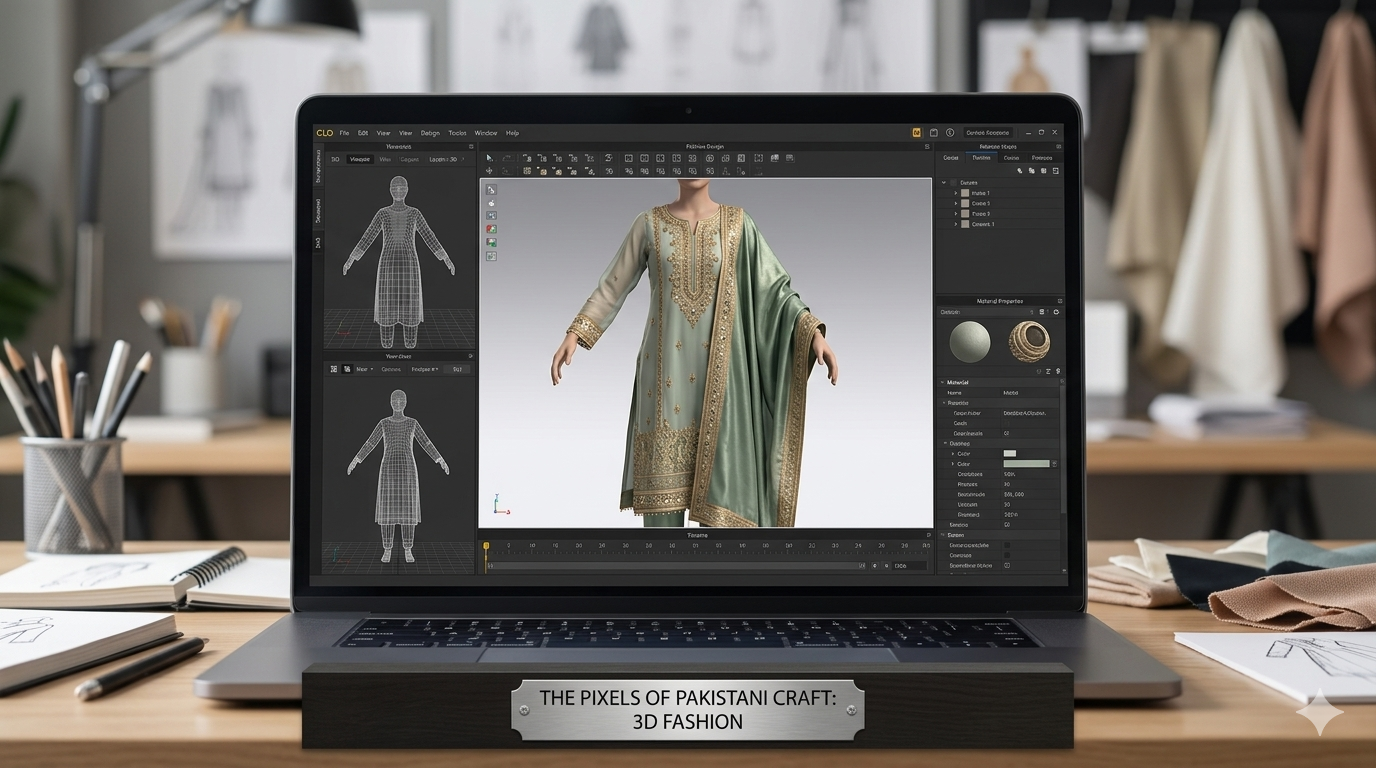
[An exclusive header image depicting a hyper-realistic 3D render of a traditional Pakistani garment. The dead center of the image contains the bold, white text: “THE PIXELS OF PAKISTANI CRAFT: 3D FASHION”.]
What is 3D Fashion, Really?
At its simplest, 3D fashion is the creation of garments in a digital environment, where patterns, fabrics, textures, drape and illumination behave in near real physics. Designers can build garments virtually, animate them, render them in lifelike detail and showcase them on digital avatars or even in augmented and virtual reality.
In the last few years, the adoption of 3D fashion workflows has exploded. According to a 2025 report by McKinsey & Company, over 40% of global fashion brands were using some form of 3D design or visualization in their product development cycle, up from about 10% just three years prior. This leap has been driven by speed, sustainability demands, cost pressures and the growing influence of digital marketplaces. Brands that once relied solely on physical samples are now launching complete digital collections months before any fabric even hits the cutting table.
The Business and Economic Impact
Translated into business impact, the numbers are striking. Companies that integrate 3D fashion into their development cycles report up to 30-50% reductions in sampling costs, 30-40% faster time to market, and a significant drop in material waste. The reality is, luxury and mainstream brands alike are fast adopting this technology:
Adidas: Accelerating product iterations and reducing physical sample rounds, shaving weeks off the timeline.
Tommy Hilfiger: Announced that by 2023, it was using 3D tools in every major product line, leading to 75% fewer physical samples for seasonal collections.
Nike: Launched digital avatars and rendered products directly into its e-commerce channels.
And this is just the beginning. As metaverse platforms mature, we are seeing avatars wearing 3D clothing in virtual fashion shows, digital wardrobes being bought and sold as NFTs, and gaming worlds becoming new fashion runways.
The Opportunity for Pakistan
So how does this translate to the Pakistani industry?
First, we have deep textile expertise. We produce fabrics, prints and embroideries that many global designers admire. That base gives us a head start.
Second, we have a burgeoning digital creative class. Pakistan’s freelance and digital design community is thriving.
Third, digital fashion doesn’t require hundreds of thousands of dollars to enter. A laptop, the right software, and creative instinct are enough.
Imagine a designer in Lahore pitching to a boutique buyer in Paris. Instead of flying physical samples, they send a 3D lookbook, an interactive set of renders that show how a chiffon kurta flows in the breeze, how embroidered details catch the light, how a silk dupatta pairs with trousers. The buyer experiences the garment from every angle, on avatars of different body types, in simulated lighting conditions.
This is not just tech. This is craftsmanship in a new medium.
Navigating the Barriers
But let’s be honest. There are real barriers as well. 3D fashion tools have steep learning curves. Softwares like CLO 3D and Browzwear are powerful, but also expensive.
This gap is starting to be recognized. Some institutions in Pakistan, like the National College of Arts (NCA) in Lahore and Indus Valley School of Art & Architecture in Karachi, have begun introducing digital fabrication, CAD and experimental media courses. But this needs to scale. Industry clusters, trade bodies, and government agencies must subsidize training and incentivize studios to adopt 3D workflows.
Globalization of Our Cultural Identity
Imagine if Pakistani designers started releasing digital first collections, where the 3D render is the first point of contact for global buyers, before physical sampling ever begins. Imagine Pakistan curating a Digital Textile Archive where authentic crafts like Ajrak, Sindhi mirrors, Multani patterns, and Kamdaani exist as shareable digital assets. That’s not just globalization of product, it’s globalization of our cultural identity.
Conclusion: Beyond centimeters, towards pixels
Then there’s also another angle that makes 3D fashion ethical. Physical sampling and mass prototyping create waste. A 2024 industry case study showed that integrating 3D sampling reduced physical waste by up to 70% in early design stages alone.
When a buyer sees a garment in 3D first, fewer physical iterations are needed. Realistically speaking, the divide between physical and digital fashion is shrinking. Earlier, designers created, then photographed, then marketed. Now the sequence is often reversed. Render, present, validate, produce.
So now, the question is not if 3D fashion will change the industry. It already is. The question for Pakistan is when do we stop watching and start building. Because the next global fashion wave won’t be measured in centimeters of fabric, it will be measured in pixels, render times and interactive experiences.