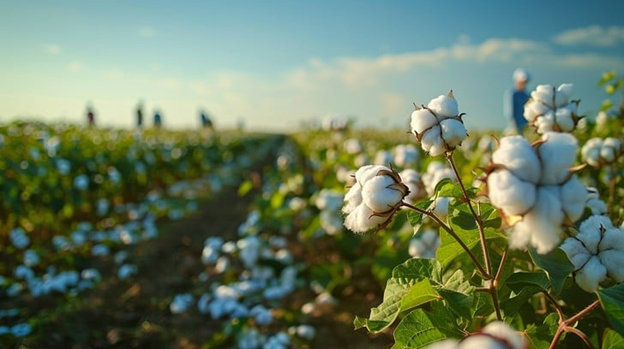

For Pakistan, cotton is more than a crop. It acts as a historic livelihood. And it’s the invisible thread which connects the farmers to the factories. It is our white gold. It is what our textile sector was built on and Pakistan was placed among the top countries that produced cotton globally. But today, that gold thread is unravelling.
Pakistan used to stand as the fourth largest cotton producer in the world, and our mills and exports were abundant with locally grown fibre. At that time, cotton accounted for 60% of Pakistan’s export revenue, and millions of people across the country were employed in the agricultural and manufacturing of cotton goods
But that leadership has slipped. According to the USDA’s 2025 outlook, Pakistan’s cotton production is projected at 4.8 million bales, down nearly 4% from last year, with cultivation area shrinking by 7.5% to about 1.85 million hectares. Meanwhile, imports are expected to surge to 5.6 million bales, and could even hit 7 million due to flood-related damages.
What once was the country’s pride has now become its dependency.
The decrease in local cotton creates a ripple effect that extends beyond the fields and farmers. The entire textile value chain has been disrupted by this decline. From ginners, spinners and all the way to garment exporters. The small and medium manufacturers are affected the worst, and they make up the backbone of Pakistan’s textile industry ecosystem.
Import dependency causes unpredictable prices, inconsistent quality and logistical delays and this squeezes the already thin margins. Many factories which had a stable domestic supply to rely on now struggle with rising input costs and uncertain delivery times. When the production of cotton suffers, so do the workers and this puts thousands of livelihoods at risk.
The causes of this decline in cotton production are many, but all tie in together to create this result. One of the main problems is climate shocks, like erratic rains, prolonged droughts and catastrophic floods which wipe out massive tracts of farmland. Also, Pakistani seed quality has worsened over the years and there is insufficient research investment, which means competitors like India have progressed in biotech adaptation. Farmers do not have the knowledge or resources to combat pests or adapt to changing weather conditions due to the neglect of farm extension services. Lastly, but most importantly, there is an inconsistency with the government policies. Fluctuating tariffs, high taxation and delayed refunds have consistently depleted business confidence in the textile chain.
Pakistan’s cotton belt, which spans from Rahim Yar Khan to Sanghar, was once the pride of the rural economy. These once prosperous fields are now neglected.
However, not all hope is lost and I really want to focus on what can be, rather than what was. Cotton can and is rising again and there are lots of programs currently underway for the revival of what was once our ultimate pride.
For years, cotton research was done solely by the Pakistan Central Cotton Committee (PCCC) and a handful of provincial research institutes. But years of underfunding had slowed the progress. Today, that tide is shifting. The government is taking concrete steps to revive R&D by integrating PCCC with the Pakistan Agricultural Research Council (PARC) to create a stronger, more unified research framework under an integrated Cotton Wing. New seed trials, pest resistant varieties and improved farming techniques, especially those involving technological advancements and resource management, are being tested across major cotton belts to rebuild both quality and yield.
At the same time, sustainability has entered the conversation and this is where the most exciting change is happening. International initiatives such as the Better Cotton Initiative (BCI) and its local partner, WWF-Pakistan, have been training thousands of farmers across Sindh and Punjab in water management, reduced pesticide use and better soil health. The goal is simple but powerful; to make cotton farming both ethical and economically viable.
The private sector also is playing its own part. Among the leaders is Artistic Milliners, a leading denim and premium woven manufacturer and a name that has gone far beyond manufacturing. The company is running programs to promote organic and indigenous cotton cultivation especially in Balochistan, where they work closely with local farmers and communities to revive native cotton varieties and empower women pickers. Their model blends traceability, community uplift and environmental restoration, proving that sustainability and scale can go hand in hand.
Other industry players are following suit partnering with NGOs and global fashion brands to trace cotton back to its origins, invest in cleaner farming methods and introduce regenerative practices. Meanwhile, organizations like CABI are leading the movement for non-GMO, organic cotton and knowledge exchange between scientists and farmers.
Together, these efforts from government research labs to private farms in Balochistan can transform the entire cotton ecosystem.
That said, there’s still such a long way to go and it’s high time that both the Government of Pakistan and the textile industry take bold, transformative steps to revive this sector, the true backbone of our economy.
Pakistan must prioritise better R&D and introduce seed varieties that are high yielding, climate resistant and pest resistant.
Moreover, Pakistan’s farm extension systems need to be rebuilt from the ground up to provide farmers with the clear, practical guidance they deserve. Smallholders, in particular, must be empowered through training in modern cultivation techniques, effective pest management and efficient irrigation practices. While efforts are underway, they remain far from the scale required to create real, nationwide impact.
In recent years, the volatility of the climate has affected cotton crops heavily, so measures to combat this must be taken. Flood-resistant drainage systems, canal restoration and water-efficient irrigation can protect crops.
Cotton takes time to become the final product, which means it requires long-term policies. These policies, which consist of price support and import duties, should be consistent to encourage investment. Also, global buyers want transparency and if Pakistan establishes traceable ethical networks from farm to fabric, it can gain an advantage. Farmers should also be linked to markets by the provision of affordable credit, crop insurance and digital tools. This can help make the supply chain more resilient.
Cotton is a national story, not just an agricultural one. Pakistan’s entire textile industry falters when cotton falls, taking millions of dreams with it. However, the road to recovery is truly not out of reach.
The land is ours. The labour is on us. Most importantly, we have the legacy.
Regaining our place on the world textile map is the goal of Pakistan’s cotton revival, which goes beyond economics. I am confident that our white gold will once again shine as a crop and as a representation of our strength. We are on an upward trajectory already, and as a nation, we have the potential to rebuild our fields with the same tenacity that has allowed us to construct our factories, bit by bit