
Exploring Pakistan’s Next-Gen Sustainable Textiles
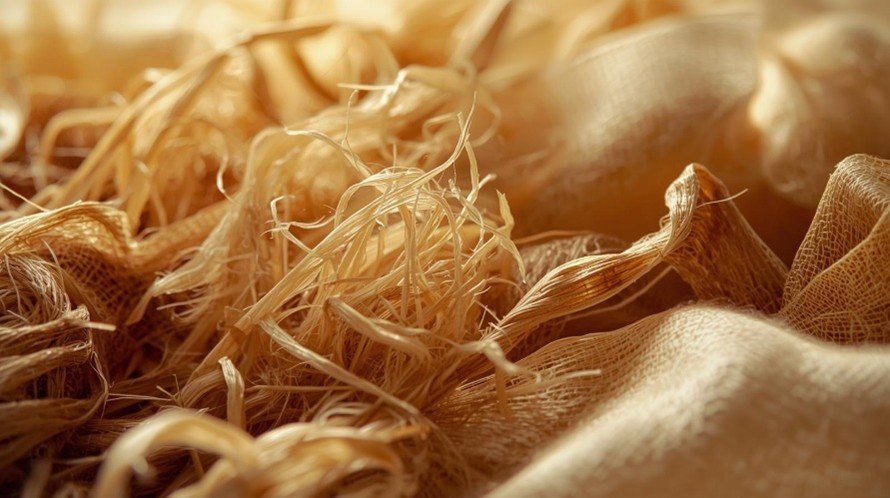
While peeling a banana this morning, I suddenly remembered my uncle, Ali Zain, talking about a mill working on the R&D of banana fiber. And so I looked at the fibrous stringy bits of the banana peel and thought that this right here in my hand was quite possibly Pakistan’s next big textile revolution!
Yes, really.
For decades, the country’s sustainability conversation has revolved around organic cotton, Better Cotton, recycled polyester and water saving denim. But under the surface, in the fields, farms, private mills and university labs, Pakistan is researching the next generation of fibers that could reshape how the world thinks about Made in Pakistan. Banana, coconut husk, pineapple leaf, hemp, Lyocell, regenerative cotton and even experimental blends. All these are being explored.
Pakistan is finally showing the world it can grow more than just cotton.
Let’s start with Banana Fiber
Banana fiber is gaining traction in Pakistan through a mix of academic passion and entrepreneurial curiosity. National Textile University (NTU, Faisalabad) has been running extraction and yarn forming experiments for nearly three years. Their teams have tested decortication methods and yarn blending with cotton, jute and viscose.
Sindh Agriculture University and independent Sindh based research groups are exploring banana stem waste from Matiari, Tando Allahyar and Thatta, areas known for banana cultivation.
A small but growing circle of private textile R&D labs in Karachi and Lahore have started spinning banana-cotton blends to test tensile strength and dye uptake.
Early samples show fabrics that could compete with linen. Crisp, strong and environmentally guilt free. Even farmers are warming up to the idea because banana stems, once landfill material, suddenly have monetary value.
Next up, the Coconut Husk Fiber
Now this one is interesting. Pakistan doesn’t grow coconuts at scale like Sri Lanka or the Philippines, but Karachi and coastal Sindh do produce enough coconut husk to catch researchers’ attention.
Coconut husk fiber, better known globally as coir, is extracted from the thick, fibrous husk of the coconut and while historically it has lived a modest life in mats, ropes and floor coverings, new research is giving this rugged material a second identity. International studies over the past decade have highlighted coir’s inherent strengths. High durability, natural resistance to salt and microbial decay and a structure that performs remarkably well in moisture rich environments. Researchers experimenting with needle punched nonwoven blends have found that coir maintains excellent absorbency and dimensional stability, two qualities crucial for technical textiles and geotextiles
Pakistan’s textile scientists, including teams at NED University, have increasingly referenced coir within broader natural fiber research particularly in the context of exploring locally available, biodegradable reinforcement materials that can reduce dependence on synthetic nonwovens.
This research is still in its early stages, but there is huge potential in coconut husks gaining momentum and transforming the sustainable fiber narrative.
Pineapple Leaf Fiber
Pineapples are grown in small pockets in Sindh and even smaller pockets in Balochistan but the fiber potential is surprisingly high.
A collaborative study between NTU and a private spinning mill in Lahore tested pineapple leaf fiber (PALF) in 2024. The results showed excellent tensile strength, but limited commercial scale availability.
PALF is still at the promising but niche stage. But if Pakistan can manage to turn banana waste into luxury fabric, pineapple isn’t far behind.
Hemp
Pakistan’s hemp story is fast gaining momentum.
NARC and PARC (National and Pakistan Agricultural Research Councils) have been studying industrial hemp as a climate resilient crop. NTU, NED and UET Lahore are conducting trial spinning for hemp-cotton blends. At least three major mills in Pakistan have produced prototype fabrics for export buyers.
Why the sudden interest? It is because hemp grows with 70% less water, regenerates soil, thrives in Pakistan’s climate, has the strength of linen and dyes beautifully
Brands abroad are already asking for hemp blends from Pakistan even though commercialization is still in early phases.
Lyocell
Globally, Lyocell is no stranger. But in Pakistan, it has just started to make its mark. Made from wood pulp and known for being soft, strong and breathable, it is far more environmentally responsible than older viscose type materials
Artistic Milliners, Crescent Bahuman, Sapphire and US Denim have already experimented with Lyocell blends for their premium denim lines. Several Lahore based vertical units have run pilot Lyocell-cotton shirting blends.
Lyocell is Pakistan’s ticket into the value added luxury market but scaling requires serious investment and patience.
Regenerative Cotton
This is basically cotton with superpowers. Better Cotton Pakistan, WWF and a few private farming groups are running regenerative cotton pilot plots in South Punjab and interior Sindh.
Early results show enhanced soil carbon, increased yields, reduced water usage and improved farmer income stability.
So what exactly is regenerative cotton? Regenerative cotton is cotton grown using farming practices that rebuild the soil, restore ecosystems and improve the land over time instead of depleting it. It’s not just sustainable, it’s restorative. Think of it as cotton that leaves the land better than it found it.
A few progressive mills including denim giants are exploring long term programs tied to global climate commitments. This just might become Pakistan’s most powerful sustainability story within the next five years.
Even more Husk Fibers in the works
Believe it or not, there’s more. Pakistan’s innovators are dabbling in
- Rice husk fibers for nonwovens
- Sugarcane bagasse fibers for reinforcement materials
- Wheat straw fibers for biodegradable packaging
None are commercial yet but the research is being done and we will soon see a new generation of textiles made from agricultural wastes.
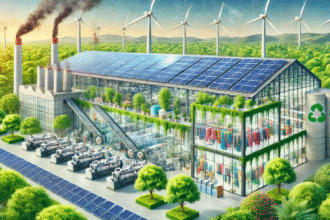
Pakistan is now evolving from a cotton dominant textile nation into a multi-fiber innovation hub. A country known for basic fabrics is now becoming the laboratory for the future of eco-fibers.
Will all of these fibers become commercial? Probably not. Will some of them redefine Pakistan’s export story? Absolutely.
What’s exciting is that Pakistan is no longer playing catch up. It is experimenting. Innovating. And sometimes turning a banana stem into a fabric that could walk the Paris runway.
The future of Pakistan’s textile industry might just be woven from the most unexpected materials. And honestly for me, that’s the most thrilling part.