
How Pakistan Is Adapting to the Future
We’re living in unprecedented times, where AI is soon going to take over every aspect of our lives. However, within the Pakistani manufacturing industry, specifically the garment and textile SMEs, there seems to be business as usual with very few business owners even focusing on the technical advancements this industry is moving towards and Artificial Intelligence taking center stage!
Now let’s imagine a factory floor where a camera spots a minute tear in a grey roll before it ever reaches the dying facility, where a machine quietly texts a technician that a loom bearing will fail tomorrow, where designers feed a handful of trend images into a software and a palette of market ready prints pops out, all while a production manager watches yield climb and rejections fall. This is not sci-fi. It’s what AI is doing to the garment world and Pakistan, with its massive textile base and export ambitions, is now slowly waking up to the possibilities.
Textiles and garments are the backbone of Pakistan’s manufacturing exports and a huge source of jobs. That scale makes even small productivity gains enormously valuable. Fewer wasted rolls, fewer rejected shipments, smoother lines and stronger bids for brand contracts that now demand traceability and sustainability. Adopting smart technology can now make it possible for manufacturers to prove compliance and keep the margins intact.
So what does AI actually do on the floor?
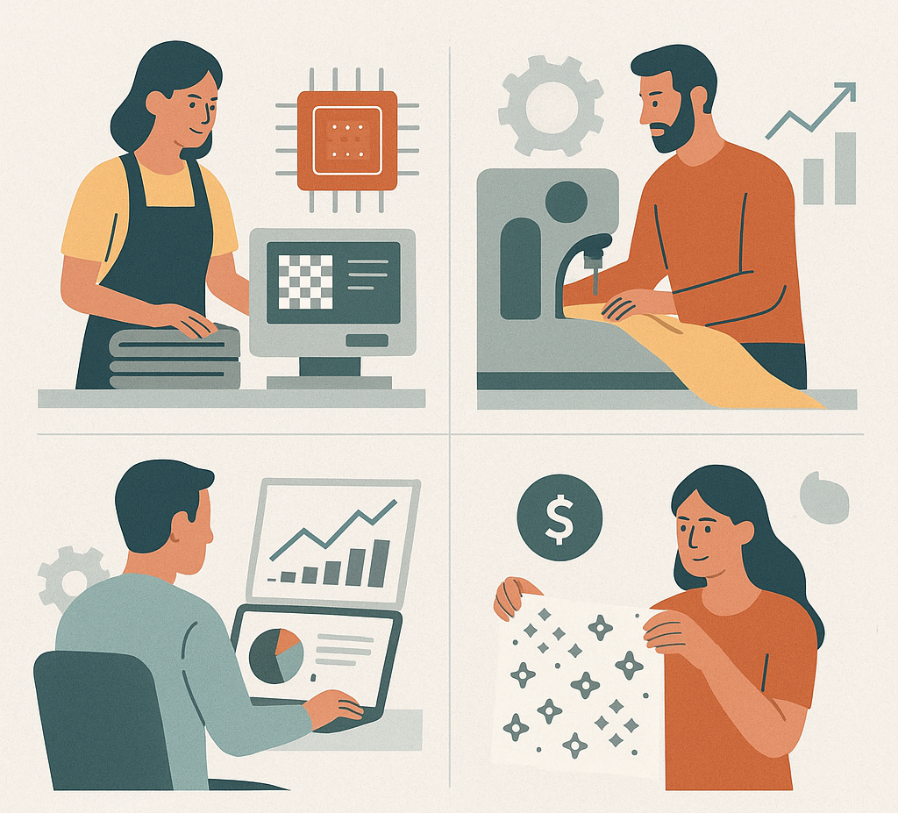
Intelligent quality control:
High speed cameras and trained softwares scan fabric and seams to flag stains, holes, missed stitches or pattern shifts in real time catching defects humans miss or spot slowly. There are many systems from smaller local teams to global vendors that are being trialed in Pakistan.
Predictive maintenance:
Sensors and Machine Learning predict machine failures before they happen, cutting unplanned downtime and saving costly emergency fixes. Pakistani pilots have already been reported.
Demand forecasting & inventory optimization:
AI models now read the industry data in real time. Orders flowing in, returns coming back, seasonal patterns shifting and social trends. By connecting these dots, they help manufacturers offer true demand, cutting overproduction at the source.
Design and customization aids:
From AI assisted print generation to trend scanning tools, designers can iterate faster and offer rapid micro collections for fashion forward clients.
All these systems and developments are in place around the world but where exactly is Pakistan standing?
I have recently heard of a Pakistan built system called IntelliInspect, developed by a Pakistani engineer / team. It claims high accuracy detecting defects across knitted and woven fabrics, scanning both grey and finished textiles in real time. Early trials showed accuracy rates in the 90%+ range on thousands of samples. Detection times were fast enough to be factory friendly. That’s exactly the kind of locally tuned solution that matters because it understands the fabrics, lighting and workflows Pakistani mills actually use.
Another local case is an AI predictive maintenance rollout for a major textile mill, developed to monitor equipment behavior and anticipate failures, reducing downtime and maintenance costs.
These pilot projects show that the technology is not merely theoretical, it’s being implemented, adapted and yielding measurable gains even in Pakistan
So let’s talk about the set up. AI in manufacturing needs three things. Cameras or sensors and edge compute (hardware), labelled data to train models (e.g., images of defects) and people who can close the loop (technicians and data-savvy engineers). Vendors, both global and local, provide specific cameras and models, but local success depends on the data. Factories that log defects, tag examples and iterate models beat generic installs. Research from regional groups and universities is also producing hybrid deep learning models tailored to textile defects, which helps local adoption.
However, let’s be real. Even with a handful of technologies that have been introduced to the Pakistani manufacturing sector, there are quite a number of challenges that we face as an industry. And we have to address them head on if we are to adopt technology and stay at par with global manufacturing practices.
Upfront cost & cash squeeze:
Machines, cameras and integration aren’t cheap. With many mills under financial pressure already and some even shutting due to policy and liquidity strains, the initial capex is a huge barrier, especially for SMEs.
Skills gap:
Engineers and line supervisors have to learn new workflow systems. From data labelling to interpreting software alerts, everything needs to be learned from zero, quite literally. Training programs are there but they are still in very initial stages.
Power and connectivity:
Reliable electricity and stable on site connectivity make AI systems work best. Where infrastructure is shaky, we need solutions that are rugged and offline capable.
Worker anxiety:
Automation raises worry about jobs. This narrative must shift to augmentation. AI must be seen and promoted as a tool to reduce repetitive strain, improve safety and raise wages through higher productivity, not take away jobs. This will require deliberate reskilling programs.
Keeping all these issues in mind, what can the Pakistani industry actually do, to slowly move towards AI enablement in the industry?
Start with low-hanging fruit:
Pilot AI inspection on a single critical line (e.g., knit or dye house) and measure defect reduction and yield improvement. Local success stories lower the fear of investment.
Public private partnerships:
Government incentives for technology pilots, tax credits for capex on sustainability tools, and industry association programs can defray upfront costs.
Skill pipelines:
Short vocational trainings for technicians on AI-assisted QC and maintenance, partnerships with universities for applied research and internships.
Data commons & shared models:
Smaller mills can pool anonymous defect images to build robust models they could not create alone, a sort of a cooperative AI for SMEs.
Automation has to be paired with worker protections, safety measures (especially heat and fire safety) and transparent transition plans. The human cost of change is going to be huge in the long run and the most resilient factories will be those that balance the upskilling and worker health as part of their tech plan.
AI won’t replace the craftsmanship and speed of an experienced sewing operator overnight but it will become a trusted teammate by catching what a human eye misses, stopping an expensive machine breakdown and letting designers test faster.
For Pakistan, which is currently struggling to maintain its competitive edge in the global textile industry, it needs productivity, sustainability wins and better proof points for global buyers. We need to pilot wisely with AI, invest and upgrade our people and sell the change to buyers as verified gains (fewer defects, stable deliveries, documented sustainability).
So if you work on a factory floor reading this, pick one line, one measurable pain point and run a three month AI pilot. If you’re a buyer, ask for factory metrics, not false promises. If you’re a policymaker, make low cost finance and training programs part of the industrial toolkit. Pakistan’s garment industry has the talent and potential to turn smart tech into real jobs, cleaner production and stronger export growth without leaving its people behind.