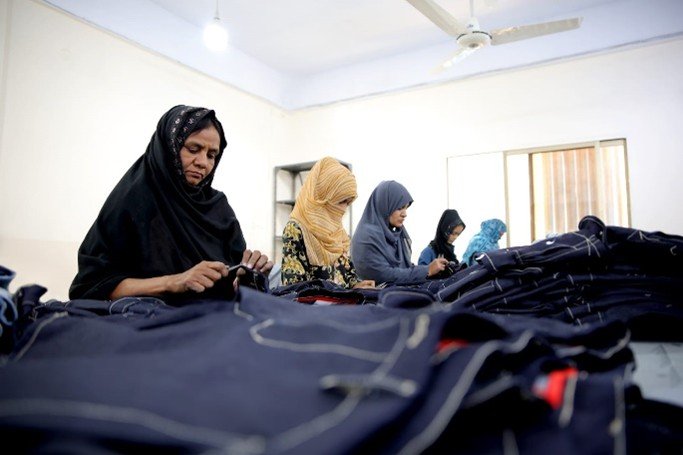

Initially, when I planned to write about the women of Pakistan’s textile industry, I thought I’d focus on the well known faces. The women CEOs, the heads of departments, the elite ladies of textiles. But last night, I got this deep urge to completely change the script and talk about the women whose names we rarely hear, the ones who work silently in the background, balancing their households and factory pressures. They are the invisible backbone that keeps the textile industry and much of Pakistan’s export economy alive through the most fragile circumstances.
So, instead of writing about success that’s celebrated, I chose to write about resilience that’s often overlooked. This story belongs to the women who never had a platform, but are building one for others to stand on.
The Informal Textile Labor
In textile hubs like Karachi, Lahore, Faisalabad and Sialkot, a huge part of Pakistan’s formal and informal textile labor consists of women who work as stitching operators, packers and finishers. This informal workforce is those women who work from their homes, completing orders, stitching, embroidering or finishing garments without ever stepping into a factory.
A few years ago, my factory signed an MoU with MITI, an NPO, providing vocational training to those belonging to the marginalized community. One of their courses was industrial stitching and we showed great interest in inducting their female students. However, we found that over 90% of those girls were not allowed to work outside of their homes. So we did a trial run of outsourcing our finishing department to support these women, sending our products to their homes where they would finish them and send back the packed goods. We had heard of women in Sialkot, hand stitching footballs at home so we wanted to see if this system would work out for us as well.
It didn’t. It got too expensive for us, sending our garments to their homes, distributing them and then bringing them back to our facility. We also struggled with quality control. On the other hand, the women’s earnings rarely reflected the effort they put in, as a significant portion was taken by the thekedaar, the middleman who charged a commission for connecting them with work. They also struggled with consistency as their family environments often made it difficult for them to completely focus on their job.
However, I do believe that if we can streamline the process and formalize home based work with fair, standardized rates for the women and defined commissions for the middlemen, we can transform the narrative to a great extent.
Workplace Harassment and Health Issues
Textiles is a male dominated industry and women, even those working in female only setups have male supervisors where complaints especially of sexual and gender based harassment is rampant.
We once had a finishing lady, Zubeda*, who worked for a well known garment factory in Karachi before she joined us, at a salary package lower than her previous employment. This was because her harassment complaints at her previous workplace were ignored. The company chose to protect its managers and reputation, brushing her grievances under the rug.
With us, it was different. We are a small company, led 50% by women and things like these do not go unnoticed. Slowly, at our factory, she rose in ranks and finally became our finishing incharge, forming a team of women under her.
Women’s health is another concern that is given no weightage in our industry. There are generally no sick leaves allowed for women’s monthly cycles, no maternity leaves in most factories, no day care systems and basically non-existent health benefits.
However, transformation is happening and women like Zubeda* are redefining what it means to be a woman in Pakistan’s textile sector by challenging norms, forcing change and making sure their voices are heard. These aren’t just jobs for the women, it is a path to their freedom and their family’s shift out of poverty.
The Faces of Change
According to UN women and ILO reports, women’s participation in Pakistan’s textile industry is steadily increasing. Some progressive factories even run women only production units. Many of Pakistan’s top designers also employ only women for their factories and workshops, paving the way for a meaningful transformation and empowerment for entire families.
Here are some inspiring women and incredible initiatives in Pakistan’s textile industry.
Razia Sultana from Sialkot, who was a football seamstress, turned her home based work into a thriving business, employing dozens of women.
Then there is Shazia from Faisalabad who started as a floor helper and is now a production line supervisor, training new recruits.
In Karachi, the Women’s Training and Development Center at Gul Ahmed Mills has been transforming lives of women who have no formal education. They are now trained and work as skilled operators, earning, saving and supporting their entire families.
In Lahore, small community stitching units supported by NGOs and export houses are giving rural women opportunities to earn close to home.
Barrick Mining, the company behind the Reko Diq project aims to train Baloch women, close to the mining site in Balochistan, to make uniforms for the mine workers.
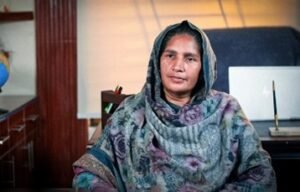
The women are now rising, weaving stories of resilience into the vulnerable fabric of Pakistan’s textile industry. And the industry is responding. Slowly but gradually. An increasing number of textile groups are integrating gender inclusive policies, offering onsite child care, safe transport, training programs and better grievance management mechanisms. What once seemed like social experiments are now becoming industry norms. Slowly, a generation of women who once stitched in silence is beginning to speak and take over global platforms.
Pakistan’s textile industry is not perfect but it is changing and women are at the heart of it all. They have turned cultural barriers into stepping stones and are reclaiming their right to work equally with men.