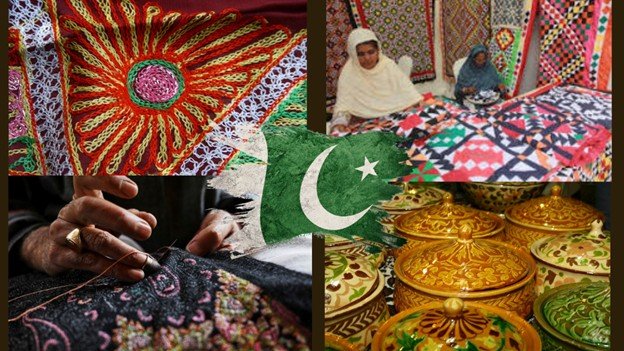

Pakistan’s crafts exist as living legacies of the hands that worked and learned over many generations. The artisans of this craft labor over every stitch and every motif, using techniques that are so refined, they can compare to the world’s most exquisite luxury craftsmanship.
From the sunny plains of Sindh to the misty valleys of Kashmir, every stretch of Pakistan carries its own craftsmanship, handicrafts and artisanal work so distinct, so deeply rooted in culture, that you won’t find anything like them anywhere else in the world! Sindhi ajrak contains deep blues and reds, coming from block printing techniques that are centuries old and use natural dyes. Ralli quilts are beautiful patchwork and these show how vast and diverse the crafts of Pakistan are. There’s colorful embroidery of Balochi taanka, intricate luxury of phulkari and chikankari and delicate intricacy in the form of sozni embroidery of Kashmir. Whole villages specialize in tie-dye chunri, handloom cottons and silks, Multani blue pottery, carved wood, lacquerware, leather tooling, truck art and hand knotted carpets, which may require months, or even years, to make. Such is the beauty of their work and so profound the pride of the hands that create it that every piece feels like a story passed down through generations.
Till a few years back, I would look around and see that these crafts were disappearing but with the world turning a tide towards nature and sustainability they are definitely not going anywhere. In fact, they are getting more popular. High-end, luxury fashion has changed priorities. And this is everything that Pakistani craftsmen have adopted for generations and excel at.
Some designers in the West have already begun to appreciate our crafts. For example, Sea, a New York brand, has used ajrak inspired prints in their collection. Even though Pakistani craft was not completely credited, it did start the conversation in the global market and showed how enticing our designs are.
In haute couture, the designer Omar Mansoor, a London based fashion designer incorporates techniques like block printing, phulkari, rali and sozni into his collections. His work is evidence that Pakistani crafts are not just traditional, but are a statement of luxury and can be seen as modern. Moreover, international media magazines like Vogue repeatedly talk about how global luxury designers are now preferring small scale, ethical models that specialize in craftsmanship, which is similar to what Pakistan offers. They want products where there is a human soul worked into it, rather than something created by a machine.
This is just the beginning. The world is eager for what Pakistan can offer, but we must execute it properly and protect its value.
The craft demand of the world is on the rise and Pakistan is taking some major steps. The country opened its first textile museum, The Haveli, in Karachi, and this is a major milestone as it is an indication that institutions are appreciating the need to preserve our heritage. The museum safeguards our cultural treasures, ensures their orderliness and shares their story with the world.
Handicrafts are now incorporated into export programs carried out by trade agencies like the Trade Development Authority of Pakistan (TDAP), and also facilitate artisans’ participation in regional fairs. Sindh and Punjab still have annual handicraft festivals that provide thousands of female artisans with firsthand experience of urban buyers, distributors and media.
NGOs and rural development groups are expanding training programs. They encourage women craft clusters by educating them on new skills, digital applications and how to make an income.
The vision is there, but it requires a clear path.
Pakistani crafts are a part of global luxury brands every now and then, but greater opportunities are still untapped. Hand embroidery shows intricate detail, symbolizing luxury. Natural dyes match sustainability requirements by importers and high end brands. Handloom fabrics show imperfections that are so human and soulful, which is something machines can never do. Ralli patchwork is like an art when done in a modern way. Block print is appealing to almost everyone and its charm is timeless. These things are what the global market is desperate for and it has existed in Pakistan for centuries.
However, in order for the artisans to gain actual credit for their work, instead of staying hidden in their villages, there needs to be a direction and organization of their work.
It is now time to shape Pakistani crafts to suit the global luxury market. Our vision is clear and we must
Establish a National Database of Artisans.
The most valuable step is to make a National Artisan Database. It will organize artisans according to their craft, region, competence, capacity and languages. Luxury consumers want to know where it comes from, designers want to know how it’s made. The database will provide credibility and globalization of Pakistani crafts.
Bring Industry and Academia together.
The academia and industry have to collaborate. Design students should work together with artisans to combine our rural crafts into new shapes. Capsule collections can allow luxury buyers to immediately witness heritage being transformed by modern design.
Develop Quality and Ethical Standards.
Luxury demands consistency. We should have simple quality manuals and standardized materials, grading and a Craft-Ethical certification that ensures fair wages, empowers women and uses sustainable materials.
Enhance Online and International visibility.
Our handicrafts should be displayed through virtual galleries, business-to-business websites and organized international craft online communities. One of the rising industries in Pakistan is digital trade and crafts should have their own place in this movement.